Sihoo M57 vs M18: Which Mesh Chair Fits You? (October 2026)
Choose the M57 for 3D armrests and a wider recline range; choose the M18 for its stated height fit and 2D armrests. Both are mesh office chairs with adjustable lumbar support and a headrest.
On this page (8 sections)
- Sihoo M57 vs M18: what are the main differences?
- Which chair gives you more adjustment?
- Which chair is more likely to fit your height?
- How do the chairs compare for lumbar and back support?
- Which armrests work better with your desk?
- Which chair should you choose for long desk sessions?
- Which Sihoo chair is the better buy for your priorities?
- Which should you pick, the M57 or M18?
Choose the M57 for 3D armrests and a wider stated recline range; choose the M18 if its stated height fit suits you. In this Sihoo M57 vs M18 comparison, your fit and the adjustments you use matter more than the model number.
Both chairs have mesh backs, lumbar support, a headrest and armrests. The clearest differences are armrest adjustment, the M57's stated recline range and the M18's stated fit for people 5'6" to 6'2".

Sihoo M57 vs M18: what are the main differences?
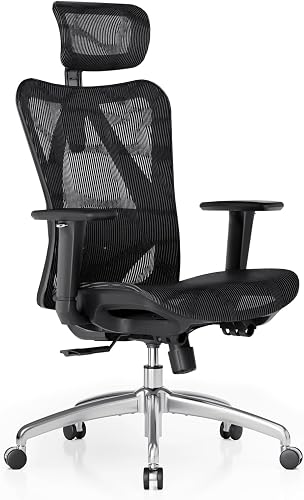
The M57 offers 3D armrests and lumbar adjustment in 2 directions; the M18 offers 2D armrests and a stated height range. The M57's listed recline range is 90° to 126°, while an angle range isn't specified for the M18.
| Feature | SIHOO M57 | SIHOO M18 |
|---|---|---|
| Armrests | 3D adjustable | 2D adjustable |
| Lumbar support | Height and depth adjustable | Adjustable |
| Headrest | Tilts and lifts | Adjustable |
| Recline | 90° to 126° | Angle range not specified |
| Stated height fit | Not specified here | 5'6" to 6'2" |
| Weight capacity | 330 lb | 150 kg, about 330 lb |
Both have a mesh back, but the M57 describes a split backrest and waterfall-edge seat. The M18 describes flexible mesh and support at the head, back, hips and hands.
Which chair gives you more adjustment?
The M57 gives you more specified adjustment for armrests and lumbar position. That can matter if you move between tasks or have a particular arm and lower-back position in mind.
Its armrests are described as 3D adjustable, and its lumbar support moves in height and depth. The headrest tilts and lifts, and the recline changes from 90° to 126°.
The M18 has 2D armrests, adjustable lumbar support and an adjustable headrest. Its information doesn't specify a recline angle range, so compare the adjustment controls in person or confirm the exact details if recline is a deciding factor.
Is the M57's recline range right for your routine?
The M57's 90° to 126° range gives you a stated spread between upright and reclined positions. Think about whether you stay upright for most work or regularly lean back for breaks.
A wider published range doesn't prove a chair will feel better to you. Your desk, monitor and preferred posture still shape how useful the recline feels.
Does the M18 have enough adjustment?
The M18 may be enough if its 2D armrests, adjustable lumbar support and headrest cover what you need. You don't need extra adjustment points if you won't use them.
If you have a specific arm position in mind, check that the M18's armrests can reach it. If they can't, the M57's 3D adjustment may be the stronger match.
Which chair is more likely to fit your height?
The M18 has the clearer stated fit guidance: 5'6" to 6'2". That gives you a useful starting range, though it doesn't guarantee the chair will match your proportions or desk.
The M57's available specifications don't give a matching height range. Check its seat height and dimensions for the exact version before choosing it based on fit.
Use this office chair height guide to set your seat so your feet rest securely and your elbows can reach the desk comfortably. If you're outside the M18's stated range, compare seat dimensions with your leg length and desk height.
For a broader shortlist, see our best home office chairs. It can help you compare other options if neither chair looks like a clear fit.
How do the chairs compare for lumbar and back support?
Both offer adjustable lumbar support, but the M57 specifies height and depth adjustment. The M18 describes adjustable lumbar and back support without giving those same adjustment directions.
The M57's split backrest is described as cushioning the back and helping relieve pressure along the spine. Its seat has a waterfall edge intended to support the thighs.
The M18 offers four support points: head, back, hips and hands. Its flexible mesh back is described as breathable, which may appeal if you prefer air to circulate behind you.
These are feature descriptions, not a promise that either chair will suit every body. If back support is your priority, check how the lumbar part lines up with your lower back and whether the seat lets you sit with your feet supported.
Which armrests work better with your desk?
The M57 suits you if you want 3D armrests; the M18 suits you if 2D adjustment is enough. The right choice depends on your desk height, arm position and whether the chair must slide close to the desk.
Measure your desk from the floor to its underside, then check the chair arm height and adjustment range. The M57's available dimensions don't include its arm height, so verify that detail if clearance is tight.
The M18's specs list an arm height of 25.4 in, but don't give an adjustment range for that measurement. Check the actual chair dimensions and your desk before relying on it.
If you prefer to move the arms out of the way, consider the SIHOO B100 Mesh Chair with flip-up armrests. It's an alternative, rather than a direct M57 or M18 match.
For more on arm support and desk clearance, read whether an office chair should have arms.
Which chair should you choose for long desk sessions?
Choose the M57 if you want the more specifically described adjustment range; choose the M18 if its height guidance and simpler arm adjustment fit your needs. Neither feature list can predict how comfortable a chair will feel over your own workday.
The M57 highlights its waterfall-edge seat, adjustable lumbar support and recline. The M18 highlights breathable mesh, four support points and a stated height range.
A good fit also depends on how you sit. Keep your feet supported, position the screen at a comfortable level and take movement breaks instead of relying on any chair to hold one posture all day.
Our guide to mesh versus fabric office chairs explains the tradeoff between an airy mesh back and other upholstery choices. If your main goal is a different kind of support, see ergonomic chairs versus regular chairs.
Which Sihoo chair is the better buy for your priorities?
Pick the M57 for 3D armrests, 2-way lumbar adjustment and a stated 90° to 126° recline; pick the M18 for its stated 5'6" to 6'2" fit range and 2D armrests. Compare the dimensions with your desk and body before deciding.
The M57 is the more specific match if you want more ways to adjust your arms and lumbar position. The M18 is easier to assess by height because it gives a stated fit range.
If neither matches your needs, the SIHOO B100 Mesh Chair adds flip-up arms, a stated seat-height range and 3 lockable recline angles. For taller users, our office chairs for tall people guide offers more fit options.
This comparison weighs the chairs' stated features against common desk setup needs. Check the exact dimensions and adjustment instructions before ordering.
Which should you pick, the M57 or M18?
Choose the M57 if armrest flexibility and specified recline matter most; choose the M18 if its stated height range matches you and 2D armrests are enough. If you need flip-up arms, compare the B100 as a third option.
Measure your desk and check the fit details that matter to your body. Then use the adjustment features as your decision rule, instead of assuming one chair suits everyone.
Frequently asked questions
Is the Sihoo M57 or M18 better?
The better fit depends on which adjustments matter to you. The M57 has 3D armrests and lumbar support that adjusts in height and depth, while the M18 has 2D armrests and a stated fit range of 5'6" to 6'2".
Compare those details with your desk setup and body fit.
What is the difference between the M57 and M18 armrests?
The M57 has 3D armrests, while the M18 has 2D armrests. If you often change arm position to suit typing, reading or leaning back, the M57 offers more adjustment dimensions.
Check the assembly and adjustment instructions to understand how each armrest moves.
Does the Sihoo M57 recline farther than the M18?
The M57's stated recline range is 90° to 126°. The available M18 information doesn't specify an angle range, so it isn't possible to make a direct maximum-angle comparison from these details.
If recline angle matters, confirm the range for the exact chair before choosing.
Which Sihoo chair has a stated height range?
The M18 is described as suitable for people 5'6" to 6'2". That range is a starting point, not a guarantee of fit, since leg length, desk height and preferred posture also matter.
Check the chair dimensions and your own seated position before deciding.
Is the M57 or M18 better for a small desk?
Either could suit a small desk depending on its dimensions and armrest position. The M57's 3D armrests may give you more ways to adjust their position, while the M18's armrests adjust in 2 dimensions.
Measure your desk height and available width, then compare them with each chair's fit.