Ergonomic Chair vs Task Chair: What Is the Difference?
A task chair is a general desk chair built for short, active work sessions, while an ergonomic chair is a task chair with adjustable support for the body. Every ergonomic chair is a task chair, but not every task chair is ergonomic.
On this page (7 sections)
The difference between ergonomic and task chair comes down to adjustability. A task chair is a general desk chair for short, active work sessions, while an ergonomic chair is a task chair built to adjust to your body.
Every ergonomic chair counts as a task chair, but plenty of task chairs skip the support features that make the ergonomic label mean anything.
That matters when you shop. A chair sold as a task chair can be a plain seat on wheels or a fully adjustable workstation tool.
The name alone won't tell you which one you're getting.
What is the difference between ergonomic and task chair in plain terms?
A task chair is a category of office chair; ergonomic is a description of how well it fits a person. The task chair definition covers the basics: a seat at desk height, wheels for moving around, and a swivel base.
Ergonomic chairs keep all of that and add support you can tune.
Think of it as a ladder. At the bottom sits the simplest rolling desk chair.
Above that are task chairs with a few useful adjustments. At the top are ergonomic chairs where the seat, back and arms all respond to your body.
The difference between ergonomic and task chair isn't a hard line in the sand. It's a question of how many parts move and how well those parts match the person sitting in them.
A cheap task chair with a fixed back fails most bodies after an hour. An ergonomic chair is designed so a range of people can find a comfortable position and stay there.
How do the features compare?
Ergonomic chairs add adjustments that task chairs often leave out. Seat height, arm height, lumbar support, headrest angle and tilt tension are the usual dividing features.
A basic task chair may offer only seat height, sometimes tilt.
The gap shows up in how the chair handles a full workday. Task chairs are built for getting in and out, moving between desks and short bursts of sitting.
Ergonomic chairs target the long session, where small mismatches in height and back angle build into discomfort by mid-afternoon.
None of this means every ergonomic chair is good. The label is common and loosely used.
What separates a real ergonomic chair from a plain task chair is whether the adjustments actually change the fit, and whether they hold their setting. Our GABRYLLY Ergonomic Office Chair Review walks through how one chair splits those features, which helps you judge the label on other models too.
What counts as a task chair?
A task chair is any office chair meant for focused desk work rather than lounging or meetings. You'll see them sold as computer chairs, desk chairs and operator chairs.
The shared traits are a swivel base, casters and a seat height that puts you at a standard desk.
Task chairs usually have a shorter back than executive chairs. The design keeps your arms free for a keyboard and lets you turn between screens without the chair fighting you.
Many have a modest recline and a height-adjustable seat, since those are cheap to add.
What a basic task chair does well
A basic task chair suits short sessions, shared desks and tight budgets. The Amazon Basics Mid-Back Task Chair is an example: it has a height-adjustable seat, tilt control, 360-degree swivel and padded armrests in faux leather.
It's rated to 275 lb and meets the BIFMA standard.
Its padded seat and backrest suit someone who sits in bursts, like a student between classes or a shared desk in an office. For long stretches, the fixed back is the limit; that's the gap an ergonomic chair closes.
Where task chairs stop short
Most basic task chairs lack adjustable lumbar support, an adjustable headrest and arm height settings. Without those, the chair fits whoever happens to match its fixed shape.
If your torso or legs fall outside that shape, you'll notice within a couple of hours.
That's the honest core of the ergonomic chair vs regular chair comparison too. The regular chair isn't bad; it's just built for a narrower range of bodies and shorter sitting time.
Our separate guide takes that pairing further if you're weighing a plain chair against an adjustable one.
What makes a chair ergonomic?
An ergonomic chair lets you set seat height, back support and arm position to your own body, and keeps those settings under load. The features that earn the name are the ones that change how the chair fits, not the ones that only change how it looks.
The usual list is seat height, adjustable lumbar support, arm height and angle, headrest position and tilt tension. A five-star base and smooth casters help too, but they don't make a chair ergonomic on their own.
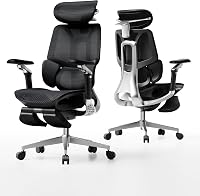
The SIHOO M18 shows what the full set looks like. SIHOO says it provides four support points at the head, back, hips and hands, with seat height, headrest, lumbar and back support adjustment.
It's aimed at people from 5'6" to 6'2" tall.
That height range is the useful detail. Ergonomic chairs are still built around a target body size, so check the range against your own height before you buy.
Our CAPOT Ergonomic Mesh Office Chair Reviews look at another mesh option with its own fit range, which is a good way to see how much the target body varies between models.
Which chair fits which kind of desk work?
Pick a task chair for short, mixed-use sitting and an ergonomic chair for long, focused sessions. A reception desk, a shared workstation or a student desk rarely needs more than seat height and a little tilt.
A full workday at one keyboard does.
The deciding question is time. If you sit for an hour at a stretch and move around between tasks, a basic task chair covers it.
If you sit for five or more hours a day, the adjustments on an ergonomic chair pay for themselves in how the seat feels by evening.
Your height and build matter just as much. A tall sitter often needs a headrest and a higher back; a shorter sitter needs a seat that doesn't press behind the knees.
The more adjustable the chair, the wider the range of people it serves. That's why the fit-by-body approach beats shopping by label.
When a task chair is the better buy
A task chair wins when the seat is shared. The Amazon Basics model adjusts height and tilt for different users without asking anyone to learn a lumbar dial.
It's also the lighter, simpler chair to move between rooms.
When an ergonomic chair is worth the extra features
An ergonomic chair wins when one person owns the desk. The Staples Dexley Mesh Task Chair adds adjustable lumbar support, a high back and height and angle settings for the headrest.
Staples says it supports up to 275 lb for 5–10 hours of daily use and includes a 5-year limited warranty.
The name on the box says task chair, but the features put it in the ergonomic group. That's the confusing part of this topic in one example: the label and the design don't always match.
Our guide to the office chair vs desk chair difference runs into the same naming overlap, since the words describe the same basic seat.
How should you choose between the two?
Start with your daily sitting time, then check that the chair adjusts in the places you need. Seat height is the floor for everyone.
From there, add lumbar support if your lower back feels the strain, arm height if your shoulders ride up, and a headrest if you recline.
Next, match the chair to your height range. SIHOO lists 5'6" to 6'2" for the M18, so a shorter or much taller sitter should look elsewhere.
Staples doesn't quote a height range for the Dexley, but its headrest and lumbar adjustments give more room to tune the fit.
Then check the build details that affect a long day. A weight rating, a BIFMA standard and a warranty tell you more about durability than the word ergonomic does.
Staples meets or exceeds ANSI/BIFMA standards and backs the Dexley with a 5-year limited warranty. The Amazon Basics chair meets BIFMA as well.
Finally, sit and adjust before you commit. Roll the seat up and down, set the lumbar where your back curves, and check the arms clear your desk.
A chair that fits at the store or on arrival will keep fitting; one that doesn't won't improve with time.
Which chair would we pick?
For most people who sit all day, we'd pick the SIHOO M18, because its headrest and lumbar adjustments cover the widest range of long-session needs. For a tighter budget or a shared desk, the Amazon Basics Mid-Back Task Chair does the short-session job at the lowest cost.
For a mesh ergonomic chair with a headrest and a 5-year warranty, the Staples Dexley sits in the middle.
The difference between ergonomic and task chair is really a question about your day. If you sit in short bursts, a task chair is enough and you can save money.
If you sit for hours, pay for the adjustments and check the fit range first.
Whichever you choose, measure your desk height and your own seated height before ordering. A well-adjusted basic chair beats a poorly set-up ergonomic one, and both beat a chair that never fit you in the first place.
Frequently asked questions
Is an ergonomic chair always a task chair?
Yes, in practice. Ergonomic chairs are a type of task chair: they keep the wheels, swivel base and desk-height seat, then add adjustable support.
The reverse isn't true, because many basic task chairs have fixed backs and arms.
Can I use a task chair as an ergonomic chair?
Only if it adjusts to your body. A basic task chair with a fixed back and fixed arms won't fit most people over a full workday.
Look for seat height, arm height and lumbar changes before treating any task chair as ergonomic.
Does the word ergonomic guarantee a better chair?
No. Ergonomic is a marketing word as much as a design one.
A chair earns the label when its adjustments match your body, so check what actually moves rather than trusting the name on the box.
How much should I expect to adjust on an ergonomic chair?
Plan on at least seat height plus one lumbar or back adjustment. Arms, headrest and tilt add more.
Each extra adjustment widens the range of bodies the chair can fit, but only if the settings stay put under your weight.
Is a task chair good enough for a gaming setup?
A supportive ergonomic task chair often works better than a gaming chair for long desk time. Gaming chairs usually sell on shape and styling, while ergonomic chairs put the adjustment range where your back sits.